
Queen Anne's County Criminal Court Records
A criminal court record is the case file kept once a charge becomes a court matter. In Queen Anne's County, that record may begin in the District Court of Maryland, move through commissioner or preliminary processes, or proceed in the Circuit Court for felony, jury-trial, and serious criminal proceedings. The file can show the charging document, court events, attorney appearances, pleas, motions, trial activity, disposition, sentence, probation, costs, and failure-to-appear or warrant entries when public.
Maryland's local structure shapes the search. The District Court handles misdemeanors, certain felonies, traffic offenses, and front-end criminal proceedings. The Circuit Court handles felony criminal cases, jury trials, and major criminal proceedings. A defendant who requests a jury trial, or a case that falls outside District Court jurisdiction, may appear in Circuit Court records. The charge-focused path is separate from the full case file, so the Queen Anne's County court charge records topic is best for the arrest-to-charge step.
Search Queen Anne's County Criminal Court Records
Maryland Judiciary Case Search is the first public lookup for District Court and Circuit Court criminal case information. Search by defendant name when no case number is known, or by case number when a notice, docket, citation, or attorney communication has supplied it. District examples in the research included D-034-CR-26-000218, while Circuit examples used a court and category format such as C-17-FM-25-000266 for noncriminal family docket material.
- Open Case Search and select the public search path after the Maryland Judiciary notice.
- Search by defendant name, case number, or citation number if the case began from a citation.
- Use Queen Anne's County, District Court, Circuit Court, criminal case type, or date filters when available.
- Open the matching result and review charges, events, hearing dates, status, disposition, sentence, costs, and warrant-related entries if visible.
- Request certified copies or older file review from the Clerk of the Circuit Court or the District Court office that holds the record.
Online case detail is not the same as a certified court file. Some older Circuit Court material may require Papervision review at the Clerk's Office, and sealed, shielded, expunged, juvenile, or otherwise confidential records will not appear through ordinary public search. Broader Queen Anne's County court records access also includes civil, family, probate, docket, and Sheriff's request routes.
Queen Anne's County Criminal Case Flow
Criminal court records grow as the case moves. Early entries identify the charging document, defendant, court, and next hearing. Later entries can show arraignment, counsel, motions, trial settings, plea, verdict, disposition, sentence, probation terms, fines, costs, restitution, and post-judgment events. The case-flow line below is a practical reading aid, not a promise that every case has every step.
Case flow: Charges Filed › Arraignment › Pretrial / Motions › Plea or Trial › Disposition › Sentencing
| Stage | What Happens |
|---|---|
| Charges Filed | A charging document, information, indictment, citation, or commissioner-linked filing starts the criminal case record. |
| Arraignment | The charge is presented and the defendant's plea or next procedural step is recorded. |
| Pretrial / Motions | Attorneys may file motions, request hearings, discuss plea terms, or address evidence and scheduling. |
| Plea or Trial | The case may resolve by plea, bench trial, jury trial, dismissal, nolle prosequi, stet, or another court action. |
| Disposition | The record shows the current or final outcome for each charge. |
| Sentencing | A conviction may add jail, probation, fines, restitution, costs, treatment terms, or other court-ordered conditions. |
What Queen Anne's County Criminal Court Records Show
The field inventory below comes from the research file's Maryland court-record fields and criminal-record summary. Not every public result shows all fields. Some details appear only in the court file, some are redacted, and some require clerk review or a certified-copy request. The docket is often useful for schedule and event tracking, while the full criminal case record explains what was filed, argued, decided, or ordered.
| Field | What It Shows |
|---|---|
| Case Number | The court, county, year, criminal category, and sequence when available. |
| Defendant | The person accused in the criminal case, with public identifiers limited by court rules. |
| Court / Location | District Court, Circuit Court, or another venue if the case moved or belongs elsewhere. |
| Charging Document | The complaint, citation, information, indictment, or other public charging source. |
| Charges | Alleged offenses, statute or charge code when public, severity, filing date, and charge status. |
| Events and Hearings | Arraignment, motions, continuances, trial settings, hearings, warrants, and failure-to-appear entries. |
| Plea | Guilty, not guilty, or other plea information when entered and public. |
| Disposition | Guilty, not guilty, dismissed, nolle prosequi, stet, probation before judgment, or other outcome language. |
| Sentence | Incarceration, suspended time, probation, fines, costs, restitution, treatment, and other ordered conditions. |
| Financial Entries | Court costs, fines, restitution, bond, or other financial obligations when visible. |
| Restrictions | Redactions or limits for sealed, expunged, shielded, juvenile, medical, financial, or minor-related information. |
Queen Anne's County Charges vs Convictions
A charge is an accusation. A conviction is a finding or plea of guilt. Queen Anne's County criminal court records can show charges that were dismissed, dropped by nolle prosequi, placed on stet, amended, reduced, resolved through probation before judgment, or ended in acquittal. Reading only the first charge line can give the wrong result if later docket entries changed the case.
| Point | Charge | Conviction |
|---|---|---|
| Meaning | An alleged offense filed in court. | A guilty plea or finding of guilt. |
| When It Appears | Near the start of the case. | After plea, trial, or other final court action. |
| Record Risk | May remain visible even if later dismissed unless expunged, shielded, or sealed. | May carry sentence, probation, fines, restitution, and later eligibility questions. |
| Best Fields to Check | Charge status, amendment entries, nolle prosequi, dismissal, or stet. | Disposition, plea, verdict, sentence, probation, and financial entries. |
Read Criminal Dispositions and Sentences
Disposition is the current or final outcome of a charge or case. Maryland criminal records may use terms that need care. Nolle prosequi means the prosecutor chose not to pursue a charge. Stet means an inactive disposition that can be reopened under conditions. Probation before judgment is a Maryland disposition where judgment may be stayed after probation terms. Dismissed and not guilty do not mean the same thing, but both can matter for expungement analysis.
Sentencing entries should be read with the exact charge and disposition. A sentence can include active jail time, suspended time, supervised or unsupervised probation, fines, court costs, restitution, treatment, or other conditions. Failure-to-appear entries, violation-of-probation entries, and warrant activity may show later problems in the same case file. If an entry affects liberty, employment, licensing, immigration, or firearm rights, the official certified record and legal advice matter more than a public-search summary.
- Nolle Prosequi
- A prosecutor's decision not to pursue a charge.
- Stet
- An inactive Maryland disposition that may be reopened under conditions.
- Probation Before Judgment
- A Maryland outcome where judgment may be stayed after probation terms.
- Disposition
- The outcome or current status of a charge or case.
- Sentence
- The court-ordered consequence after conviction or qualifying disposition.
Public Access to Criminal Court Records
Queen Anne's County criminal court access starts with Maryland's judicial-record rules. Maryland Rules 16-901 through 16-914 govern access to judicial records and set public access as the general starting point, with exceptions for records made confidential by law, rule, or court order. Criminal court records may be public after filing, but public access does not include sealed, shielded, expunged, juvenile, or otherwise restricted material.
Maryland expungement rules also affect what the public can see. Criminal Procedure § 10-105 provides procedures for eligible police and court records after qualifying dispositions or waiting periods. Criminal Procedure § 10-105.1 addresses automatic expungement for certain eligible records under specified conditions. Eligibility depends on the case, charge, disposition, timing, and statute.
Note: Expungement, shielding, and sealing are different legal tools, and public search results should not be used to judge eligibility.
Sealed and Expunged Criminal Records
Sealed, shielded, and expunged criminal court records are not ordinary public files. Juvenile police and court records are confidential under Courts and Judicial Proceedings § 3-8A-27. The Queen Anne's County Clerk's court-records page says juvenile and adoption case records can be accessed only through court order. Mental-health and involuntary-commitment matters can also be sensitive and restricted.
| Point | Sealed or Shielded | Expunged |
|---|---|---|
| Public Visibility | Hidden or limited from ordinary public access by rule, law, or court order. | Removed from ordinary public access after the legal expungement process. |
| How It Happens | A statute, rule, or judge limits access to the record. | A qualifying petition or automatic process applies under Maryland law. |
| Common Triggers | Juvenile confidentiality, safety issues, protected personal data, or court order. | Qualifying acquittal, dismissal, nolle prosequi, stet, PBJ, or eligible conviction after the required period. |
| Search Result | The public may see no result or limited information. | The public should not find the case through ordinary Case Search once the expungement is complete. |
Queen Anne's County Criminal Court Offices
Records questions should go to the court that keeps the file. Circuit Court records, felony files, jury-trial matters, and certified Circuit Court copies route through the Clerk of the Circuit Court. District Court matters, misdemeanor cases, certain felony front-end proceedings, and many traffic-related criminal matters route through the District Court office. Charging documents, warrants, bond-related front-end processing, and initial commissioner functions may involve the District Court Commissioner station.
The State's Attorney prosecutes criminal charges in Queen Anne's County, but that office is not the public copy counter for court records. The Public Defender represents eligible people in criminal, juvenile, parental defense, and involuntary-commitment matters, but it does not provide public copies of court files. Use the clerk or court for the record, and use counsel for case strategy.
Clerk of the Circuit Court
200 N. Commerce Street
Centreville, MD 21617
410-758-1773
8:30 a.m.-4:30 p.m.
District Court of Maryland
120 Broadway, Suite #1
Centreville, MD 21617-1092
410-819-4000
8:30 a.m.-4:30 p.m. Monday-Friday except legal holidays
District Court Commissioner
120 Broadway
Centreville, MD 21617-1092
410-819-4010
Weekdays until midnight, with night and weekend on-call coverage
Federal Criminal Court Records
Federal criminal prosecutions from Queen Anne's County are not Maryland county criminal court records. They are handled through the U.S. District Court for the District of Maryland and federal PACER/CM/ECF systems. The District of Maryland homepage links PACER, CM/ECF, e-filing procedures, eJuror, and scam warnings related to jury service and arrest warrants.
The first successful manifest image for this criminal page comes from the U.S. District Court for the District of Maryland, which is the federal trial-court resource for Maryland federal criminal and civil matters.
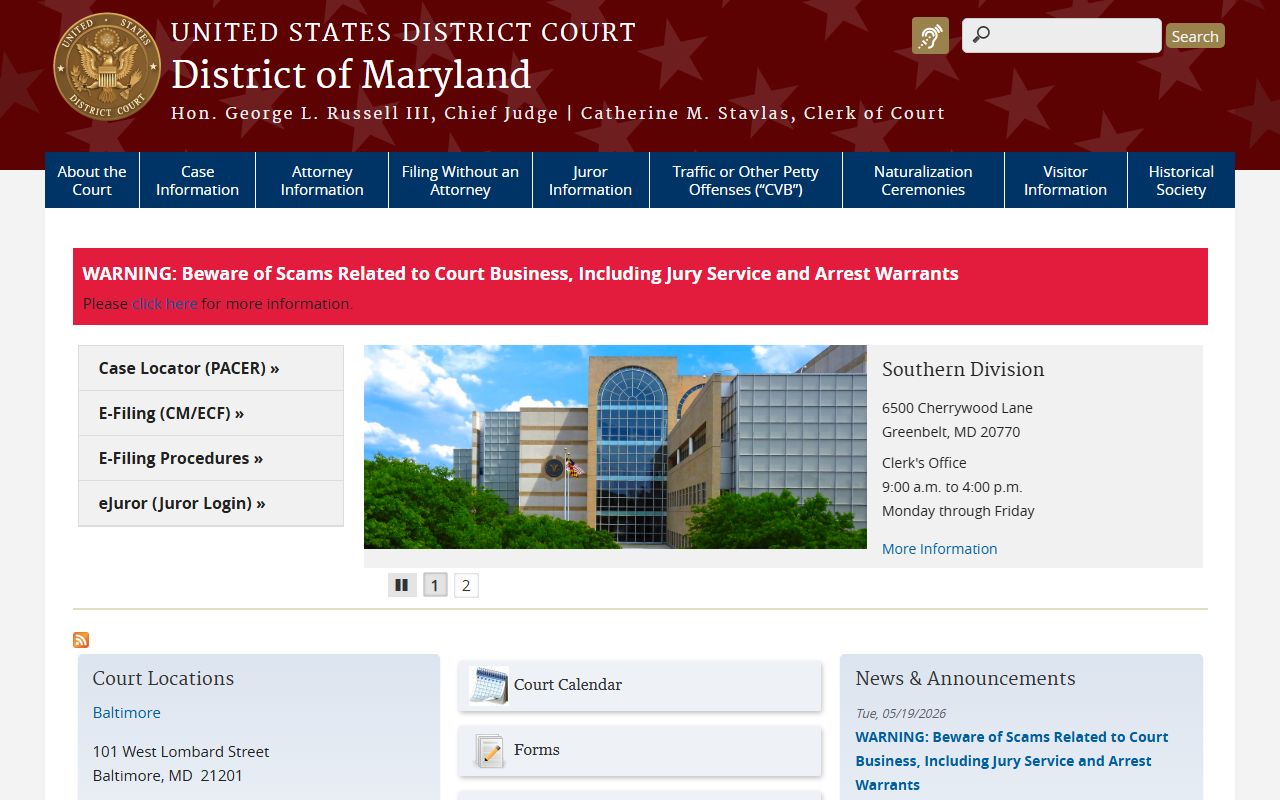
Use that federal court source only when the case is federal; state District Court and Circuit Court criminal records stay in Maryland Judiciary channels.
The official PACER lookup page for Maryland District Court identifies the federal CM/ECF court record path for District of Maryland cases.
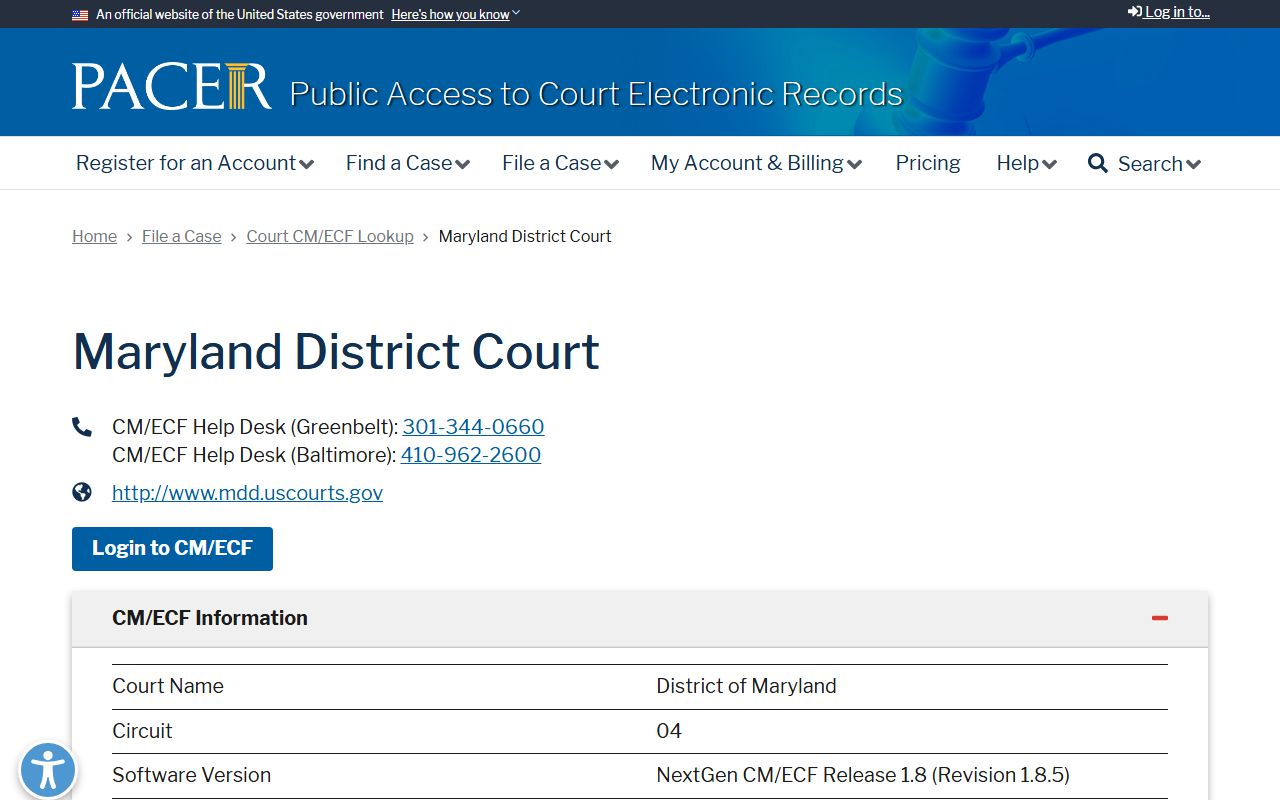
PACER can be the correct path for federal indictments, federal plea records, federal sentencing entries, and federal docket activity.
Attorneys and approved filers use the District of Maryland CM/ECF Live NextGen filing login for federal electronic filing.
CM/ECF is a filing system, while public federal case review generally runs through PACER or approved public access channels.
Federal Records Outside Criminal Court
Some federal records found during research are not criminal records at all. Bankruptcy cases are federal civil financial proceedings handled by the U.S. Bankruptcy Court for the District of Maryland, not by the Queen Anne's County Circuit Court or District Court. They can still appear in a person's broader record search, so the source must be labeled correctly.
The manifest image from the U.S. Bankruptcy Court for the District of Maryland shows a separate federal court system from Maryland criminal court records.
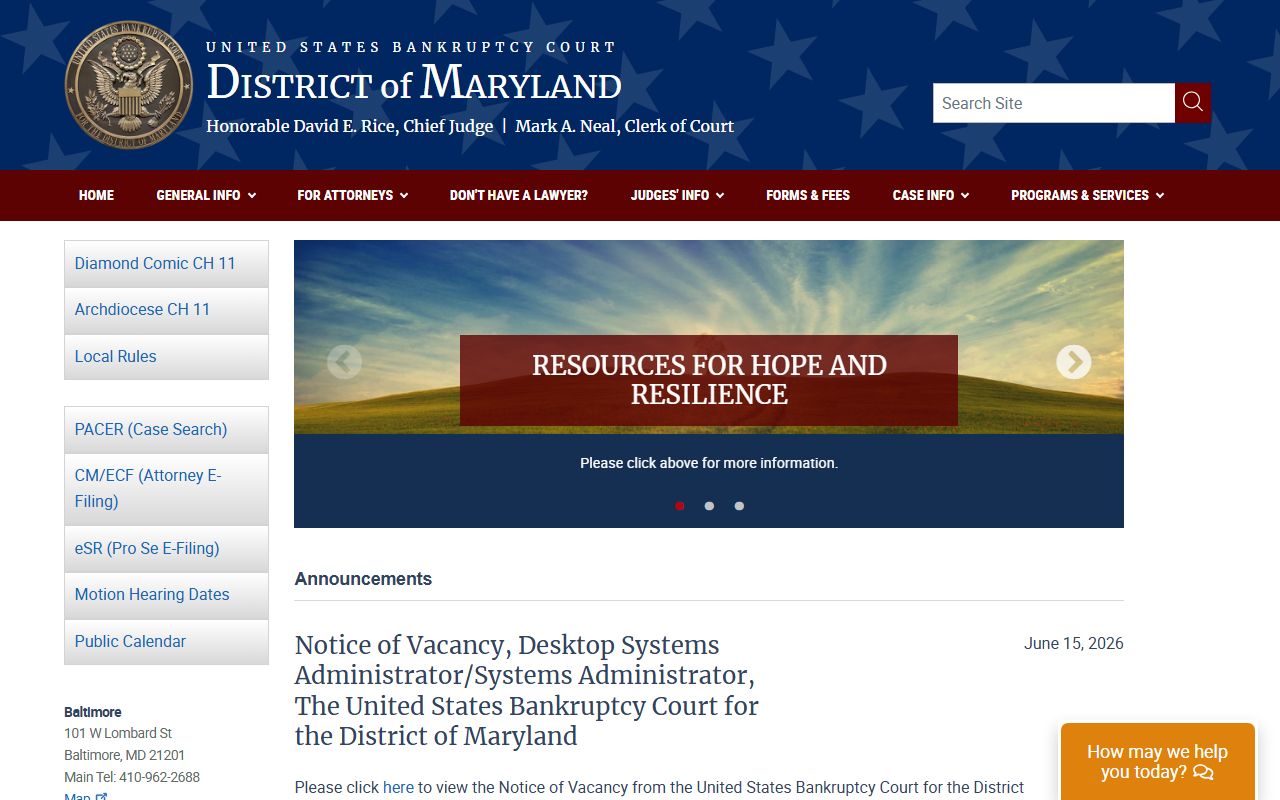
Bankruptcy materials may matter in a background review, but they are not proof of a county criminal charge, plea, conviction, or sentence.
The Bankruptcy Court locations page states that filings may be made with the Clerk's Office in either Baltimore or Greenbelt.
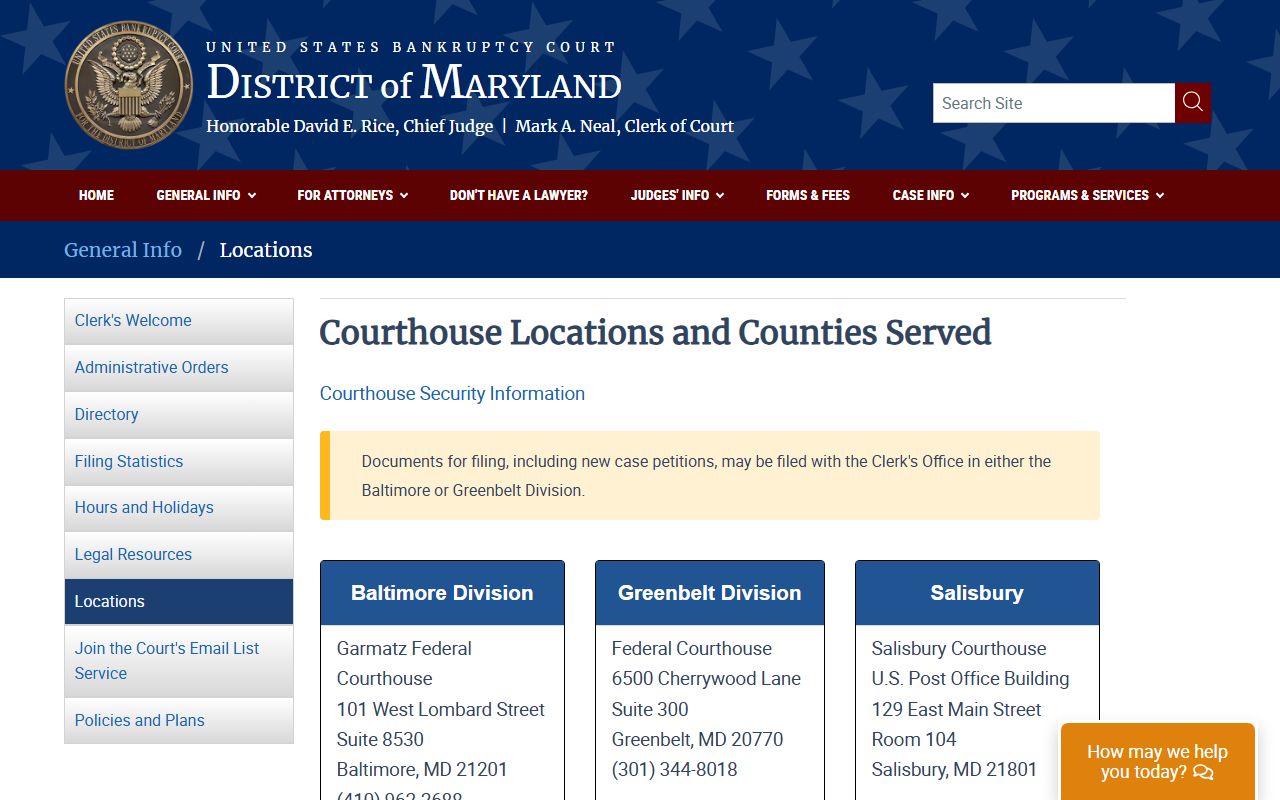
That venue detail helps keep federal bankruptcy searches separate from Queen Anne's County criminal case files.
The PACER lookup page for Maryland Bankruptcy Court is also separate from federal criminal PACER access.
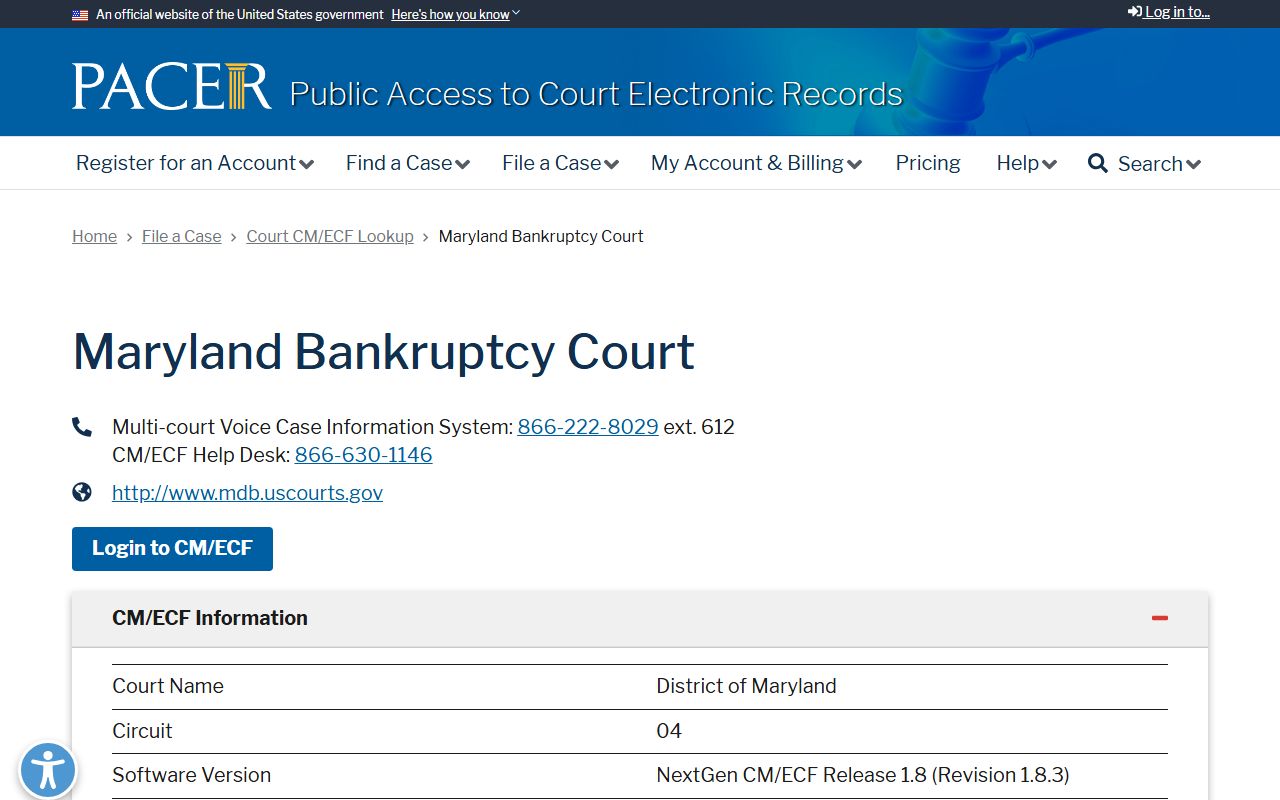
Use bankruptcy PACER only for bankruptcy records; use Maryland Case Search or District of Maryland PACER based on whether the criminal matter is state or federal.
Restricted Queen Anne's County Criminal Records
Criminal record access has firm limits. Juvenile records are confidential. Expunged, shielded, or sealed records are not available to the public through ordinary search. Certain personal identifiers, financial account numbers, minor names, medical information, and other sensitive details may be redacted. Active search warrants and investigative records can also be unavailable to the public while the matter is pending or sealed.
For a public copy, ask the court that holds the case file. For a police report or body camera record, use the Sheriff's public-information request process. For a federal criminal case, use the District of Maryland and PACER path. For a state criminal case from Queen Anne's County, start with Case Search and then verify with the Clerk of the Circuit Court or District Court office when the public result is unclear.